
What’s the best meal you’ve ever had? A wedding breakfast, a Christmas dinner, a warm Cornish pasty eaten on a cold beach as a child, Mum’s meat and potato pie? Meals stay with us, marking our lives more clearly than almost anything else, because a meal is never just food. It is memory, relationship, and meaning, all served up on the same plate.
History bears this out in some unlikely places. Take the summit of Everest, 29,032 feet above sea level, on 29th May 1953. Edmund Hillary and Tenzing Norgay, the first human beings to stand on the roof of the world, had fifteen minutes before they had to descend – and in that time they shared a bite to eat.
Their expedition had carried thirty-eight pounds of Kendal Mint Cake up the mountain, rationed sugary sweets provided by a Cumbrian confectioner still recovering from wartime shortages. Hillary and Tenzing nibbled it together at the top of the world, while Tenzing, a devout Buddhist, left an offering of food to the mountain and Hillary buried a small crucifix in the snow. A boiled sweet, shared between two exhausted men who had just done the impossible, remains one of the most quietly moving meals in history.
Sixteen years later, an even stranger meal took place 238,900 miles further away. On 20th July 1969, before Neil Armstrong and Buzz Aldrin took their first steps on the moon, Aldrin, an elder of his Presbyterian church in Texas, asked Houston for a few moments of radio silence. He opened two small plastic packets and poured wine into a tiny chalice his church had given him. In the moon’s weak gravity, the wine curled slowly up the side of the cup. He read a verse from John’s Gospel, took the bread, and ate. It was, by his own account, the first food and drink ever consumed on the moon – and it was Holy Communion. NASA, wary of controversy, kept quiet about it for years. The official first lunar meal, eaten shortly afterwards, was rather less holy: bacon squares and peach cubes, sucked from foil pouches!
Not every remarkable meal makes the history books. Mine happened in September 2001. Helen and I, with our five children in tow, had just come down from Julian, California, the Apple Pie capital of America (yeah, right?) – an underwhelming experience given the hot and arduous three-hour drive there and back.
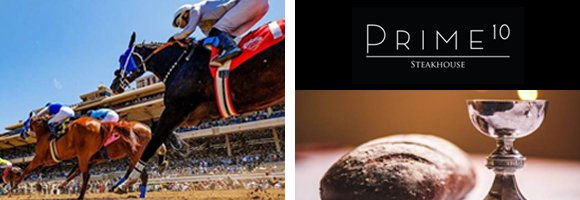
Spotting a smart, busy restaurant near our hotel, we dived in on the off chance of a meal. We were scruffy, sweaty and grumpy after a hot and disappointing day. Within seconds I realised we had stumbled into one of Del Mar’s finest starred restaurants, full of wealthy patrons in town for the annual Del Mar races – think Ascot – Armani, Gucci, Hugo Boss, it was all there in abundance. We must have looked so filthy rich that we could swan in as we were, looking as if we’d been dragged through a hedge backwards!
But Prime 10 greeted us as if we were royalty! Nothing was too much trouble: we were seated, welcomed and waited on all evening with exactly the same grace we would have received in black tie and shimmering gowns. It was, by far, the most expensive meal I have ever paid for – the best part of £400 for the seven of us (it was 2001 remember!) But it’s not the bill that has stayed with me. It was being received, welcomed and treated, shabby appearance and all, by people who chose not to hold it against us.
That kind of welcome, given without a glance whether we looked as if we deserved it or not, is what is at work in Sunday’s readings. In Exodus 12, God institutes the very first Passover: a meal eaten in haste, blood on the doorposts, unleavened bread because there was no time to wait for it to rise. Buried in the instructions is a detail easy to miss: a household too small to finish a whole lamb was to share one with its nearest neighbour (Exodus 12:4). From the very first Passover, no one was meant to eat alone and no household was too small or too poor to have a place at the table.
That is the world Matthew 18:15-20 (the linked gospel) speaks into. Jesus is less interested in church discipline than in protecting that same principle: if a brother or sister sins against you, go to them – privately first, then with one or two others – not to shame them out of the family but to win them back into it. The passage ends with an echo of the Passover table: “where two or three are gathered in my name, there am I with them.” God’s presence, like the lamb at that first Passover, was never a private possession; it belongs among the gathered, however small.
That is what happens, in miniature, every time we come to the Communion table. It is Everest’s Mint Cake, the moon’s tiny chalice and Prime 10 rolled into one: an ordinary, unglamorous meal carrying everything – rescue, neighbourliness, restoration, and Christ’s presence among his people.
You do not need thirty-eight pounds of anything, no spacesuit is required but thankfully you can just turn up as you are! Just come and receive.
Revd Paul